


-

T-Rex Encyclopedia
Its scientific name is Tyrannosaurus Rex, also called Tyrannosaurus. It is usually called Tyrannosaurus Rex, one of the most famous dinosaurs in the world. Tyrannosaurus rex lived in the late Cretaceous period. They have an average body length of 11.7 meters, a maximum length of 14.6 meters, an average hip height of 4 meters, a highest hip height of more than 5 meters, an average weight of 11 tons, and a maximum weight of 14.85 tons. They are known in the world. One of the largest carnivorous dinosaurs. In 1902, Barnum Brown, an American dinosaur fossil collector, discovered the bones of the first Tyrannosaurus rex in Hale Creek, Montana, USA. Tyrannosaurus rex has very small forelimbs, only about 80 cm in length. Compared with the huge size and hind limbs of Tyrannosaurus, the forelimbs are very small,they are unable to touch their mouth or feet, which may be useful. Just balance their huge heads. The huge head of the Tyrannosaurus rex has a huge mouth. Their teeth are as big as bananas and their bite force is amazing. According to scientists, the bite force of an adult Tyrannosaurus can reach between 100,000 and 200,000 Newtons, which can be easily They bite through the skin of other dinosaurs and snapped their bones. Probably because of this, we call them Tyrannosaurus. Tyrannosaurus Rex, Tyrannosaurus Rex Restoration PictureTyrannosaurus Rex fossil discovered by Barnum Brown
August 13,2021
-

5 Long-Necked Facts About Mamenchisaurus
China is overstuffed with various amazing dinosaurs, and today let’s take a look at one of these giant creatures.
December 24,2019
-

Paleontologists Find Rare African Dinosaur, New Titanosaur Species
Paleontologists have discovered a new extinct species of the world’s biggest dinosaur group in Africa, but the skeleton tells a strange story. Titanosaurs are most often found in South America, although they have been uncovered all over the globe. Researchers dug up a fossil that was frozen in rock in southwestern Tanzania and dates back between 70 million and 100 million years, according to the National Science Foundation. The rare African dinosaur also has a strange family story: It was more closely related to dinosaur giants in South America than its continental friends. The skeleton, of a species that has been dubbed Shingopana songwensis, was found in rock from the Cretaceous Period. The scientists analyzed its vertebrae, ribs, the upper left arm and part of the left side of the pelvis to find that the creature “exhibits morphology indicating affinities” with South American titanosaurs from the Late Cretaceous, they wrote in the Journal of Vertebrate Paleontology. But it did not have as many features in common with African titanosaurs that lived during the same time or in the same place, suggesting that the African species of these enormous dinosaurs were a diverse group rather than one that all shared a single common ancestor. “There are anatomical features present only in Shingopana and in several South American titanosaurs, but not in other African titanosaurs,” lead study author and paleontologist Eric Gorscak, from the Field Museum of Natural History in Chicago, said in the foundation statement. “Shingopana had siblings in South America, whereas other African titanosaurs were only distant cousins.” Additionally, the titanosaurs from southern Africa also had more in common with South Americans than with northern Africans. The study suggests that means that “tectonically driven separation of the two landmasses may have influenced the development of progressively isolated southern African faunas throughout the Cretaceous.” The continents were not alwa…
September 25,2017
-
Paleontologists Discover 250-Million-Year-Old New Species of Reptile in Brazil
A new fossil reptile that lived 250 million years ago in the state of Rio Grande do Sul, southernmost Brazil has been discovered by an international team of researchers. The species has been identified from a mostly complete and well preserved fossil skull.
September 19,2017
-

Utah Paleontologists Turn to Crowdfunding for Raptor Project
Millions of years ago, on a mud flat somewhere in Cretaceous Utah, a group of Utahraptors made a grave mistake: They tried to hunt near quicksand. The pack’s poor fortune has given modern paleontologists an opportunity to decode the giant raptor — its appearance, growth and behavior — but only if they can raise the money.Enter “The Utahraptor Project,” started on GoFundMe last year with a $100,000 goal. It offers backers access to a field worker’s blog, a live “Raptor Cam” and digital models of the find put together through the process of photogrammetry. While it is far from reaching its goal, the team is optimistic.“Once we get this up and running, with all the cameras and gizmos to record the action on a micro and macro level,” said Scott Madsen, a fossil preparator, “I think we can give the public a good show for their money.”Utahraptor, 23 feet long and weighing over a ton, was one of the largest dromaeosaurs, feathered, sickle-clawed dinosaurs closely related to birds. Since its discovery in 1991, it has been the subject of a popular novel, assorted documentaries and tie-in toys from “Jurassic Park.” But for all its fame, the predator has been known primarily from only a few remains. That changed in 2001, when a geology student found a leg bone emerging from a hillside in the Cedar Mountain formation in eastern Utah.Over 12 field seasons, a team of paleontologists with the Utah Geological Survey found an ever-expanding tangle of bones in the 126-million-year-old rock. When the final slab of sandstone was removed in 2014, said Jim Kirkland, Utah state paleontologist, it weighed nine tons and contained the skeletons of a herbivorous dinosaur, a 16-foot adult Utahraptor, four juveniles and a recent hatchling. The block proved too heavy for the lab at the University of Utah, and in 2015 ended up on reinforced floors at the Museum of Ancient Life at Thanksgiving Point. Mr. Madsen, then an employee of the Utah Geological Survey with experience preparing …
September 16,2017
-

Did Tiny Algae Fell Mighty Dinosaurs?
Seventy million years ago, they all came to drink in the rapidly drying river: long-necked sauropods, fierce theropods, crocodiles, lizards, and raven-sized birds. They never left. The giant and the tiny were entombed together in the riverbed, forming what is now a spectacular series of mass graves in northwestern Madagascar. Last week, researchers proposed a culprit behind this ancient mystery: harmful algal blooms (HABs), in the very water that had lured the animals.The remains of such algal blooms “should be more common in the fossil record,” says vertebrate paleontologist Nicholas Pyenson of the Smithsonian Institution in Washington, D.C., who was not part of the study. But he cautions that they are tough to prove.Bone beds always come with a mystery: Why did so many animals die at once? Floods and volcanoes are sometimes invoked, and for years researchers suspected that drought killed the animals whose fossils accumulated in the Maevarano Formation of Madagascar. Torrential rains punctuating periods of drought might have created turbulent rivers choked with sediment that buried skeletons intact.One chunk of this formation “is the most fossiliferous package of rock I’ve ever seen,” says Raymond Rogers, a geologist at Macalester College in St. Paul, who has been studying the site for 2 decades. He and his colleagues have so far cataloged nearly 1200 specimens from a single bed a third the size of a tennis court.Over time, the team grew skeptical of drought as the only explanation. Large and small animals nestle against each other, suggesting that the bodies were buried where they died and that the killer struck all kinds of animals without discrimination. In addition, whatever killed these animals “was fast-acting,” Rogers says, “dropping birds in their tracks.” And it happened again and again, creating multiple layers of bone beds.Last week, at the annual meeting of the Society of Vertebrate Paleontology here, Rogers noted the arched-back posture of …
September 15,2017
-

Unique Imaging of a Dinosaur's Skull Tells Evolutionary Tale
Researchers using Los Alamos unique neutron-imaging and high-energy X-ray capabilities have exposed the inner structures of the fossil skull of a 74-million-year-old tyrannosauroid dinosaur nicknamed the Bisti Beast in the highest-resolution scan of tyrannosaur skull ever done.
September 14,2017
-

New Dinosaur Discovery Suggests New Species Roosted Together Like Modern Birds
The Mongolian Desert has been known for decades for its amazing array of dinosaurs, immaculately preserved in incredible detail and in associations that give exceedingly rare glimpses at behavior in the fossil record.
September 14,2017
-
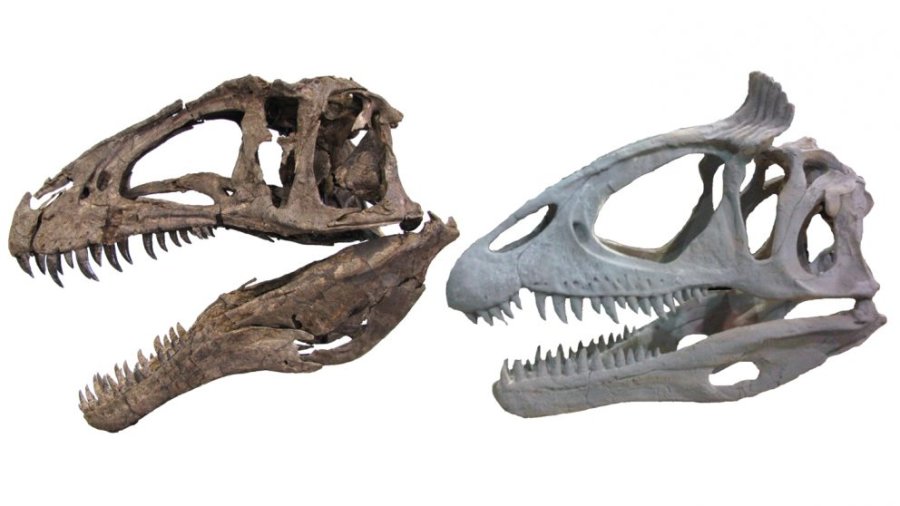
Outrageous Heads Led to Outrageously Large Dinosaurs
Theropod dinosaur species with bony crests, horns and knobs evolved to giant body sizes 20 times faster than those species lacking such embellishments, new research has concluded.
August 05,2017
-
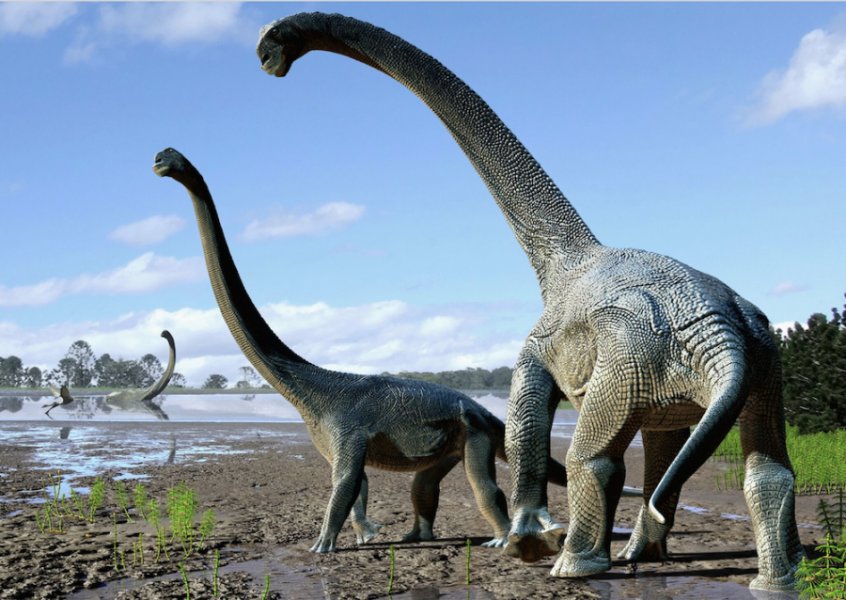
New Cretaceous Dinosaur From Queensland
Researchers have announced the naming of Savannasaurus elliottorum, a new genus and species of dinosaur from western Queensland, Australia. The bones come from the Winton Formation, a geological deposit approximately 95 million years old. Savannasaurus was a medium-sized titanosaur, approximately half the length of a basketball court, with a long neck and a relatively short tail.
August 05,2017

